➜ You left the salon with beautiful, rich colour. By week three, it looks washed out, brassy, or dull — and you can’t figure out why. You followed all the aftercare advice. You used the right shampoo. You avoided the heat.
➜ The culprit might not be anything you did. It could be the water coming out of your shower.
➜ Perth is one of the hardest water cities in Australia — and for anyone who colours their hair, that’s a problem worth understanding. In this guide, we’ll explain exactly what hard water does to your colour, how to spot the signs, and what you can do to protect your hair for longer.
What Is Hard Water — And Why Does Perth Have So Much Of It?
➜ Hard water simply means water that contains high levels of dissolved minerals, primarily calcium and magnesium. These minerals are picked up as water moves through limestone and chalk rock formations underground.
➜ Perth draws much of its water supply from the Gnangara groundwater system and the Integrated Water Supply Scheme. These sources pass through mineral-rich geology, resulting in water that consistently tests at moderate to high hardness levels across most of the metropolitan area — including Claremont, Nedlands, Subiaco, and surrounding suburbs.
To put it simply: the water that feels perfectly fine for drinking is, quietly, not great for your hair.
Quick Fact: Perth Water Hardness
• Perth water typically measures 80–200+ mg/L of calcium carbonate
• Water over 120 mg/L is classified as ‘hard’ by Australian standards
• Many Perth suburbs sit well above this threshold
• Hard water is safe to drink — but it behaves differently on porous surfaces like hair
What Hard Water Actually Does To Coloured Hair
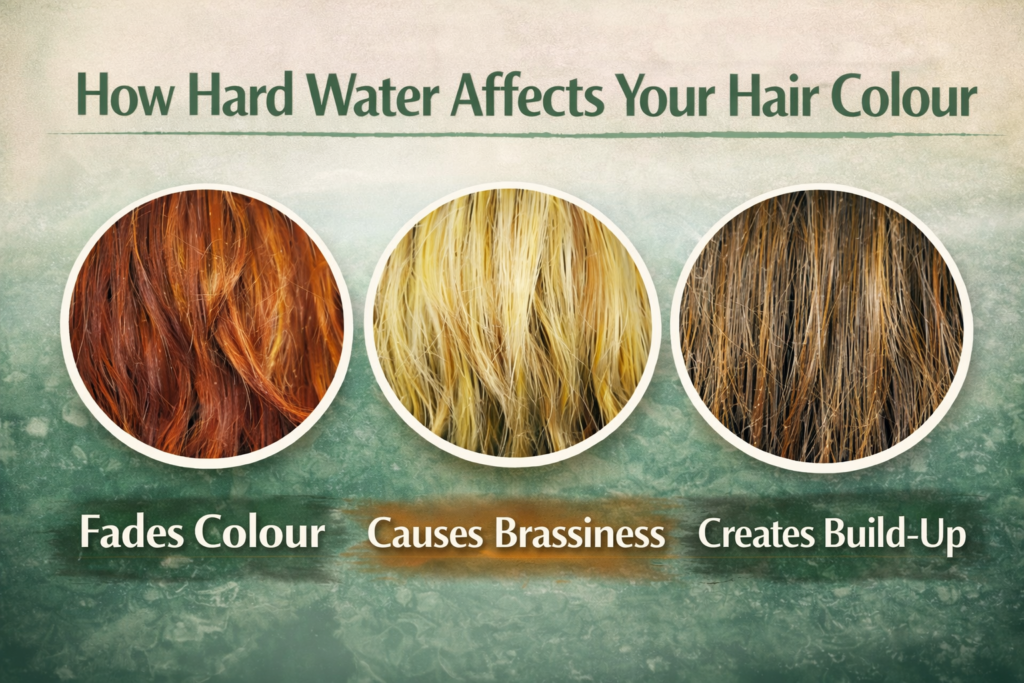
➜ Hair colour is designed to penetrate the hair shaft and deposit pigment inside the cortex — the inner layer of your strand.
➜ For this to work well, your hair’s cuticle (the outer protective layer) needs to be smooth and able to open and close properly.
👉 Hard Water Disrupts This Process In Several Key Ways:
1. Mineral Buildup Coats The Hair Shaft
Calcium and magnesium ions bond to your hair’s surface every time you wash. Over time, this creates a mineral film — almost like a coating of limescale — that makes hair feel rough, look dull, and resist moisture.
If you’ve noticed your hair feels weirdly ‘coated’ or heavy no matter how much conditioner you use, mineral buildup is likely the cause.
2. It Strips Colour Faster
The same minerals that deposit on your hair also interact with hair dye molecules. They can oxidise colour pigments, causing vibrancy to fade faster than it should. Reds and warm tones are especially vulnerable, fading to orange or copper within weeks. Blondes can go brassy. Even darker shades lose depth and richness.
3. It Raises The Hair Cuticle
Hard water has a higher pH than your hair’s natural state (which sits around 4.5–5.5). Repeatedly washing in alkaline water lifts the cuticle, leaving hair porous and rough. Porous hair is bad news for colour — it absorbs unevenly and releases pigment quickly.
4. It Makes Hair More Prone To Breakage
Mineral buildup weighs hair down and makes it more susceptible to tangling and friction damage. Combined with raised cuticles, this leads to increased breakage over time — especially for chemically processed hair.
Signs That Hard Water Is Affecting Your Hair
You might not automatically connect your hair problems to your water. Here are the telltale signs to look for:
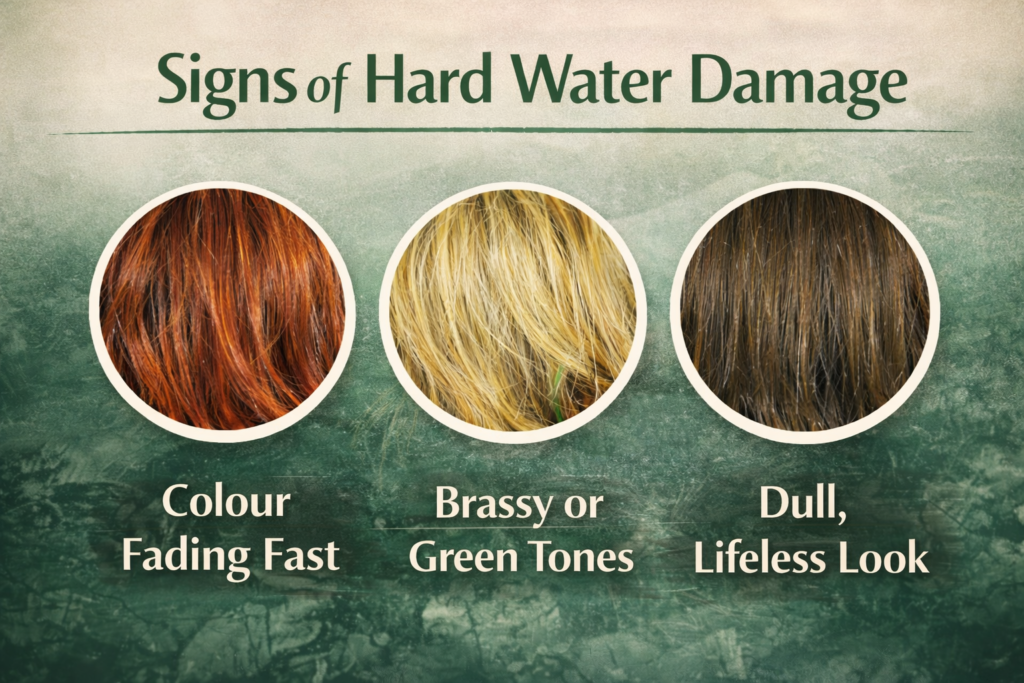
| Sign | What It Suggests |
|---|---|
| Colour fades within 2–3 weeks | Minerals are stripping pigment prematurely |
| Hair feels dry even after conditioning | Mineral film is blocking moisture absorption |
| Brassy or orange tones appear quickly | Calcium is oxidising warm pigments |
| Hair feels ‘coated’ or heavy | Mineral buildup on the shaft |
| Scalp feels itchy or flaky | Hard water disrupting scalp pH balance |
| Colour looks uneven or patchy | Raised cuticle causing inconsistent absorption |
| Hair tangles more than usual | Rough cuticle from alkaline water exposure |
What You Can Do To Protect Your Hair Colour In Perth
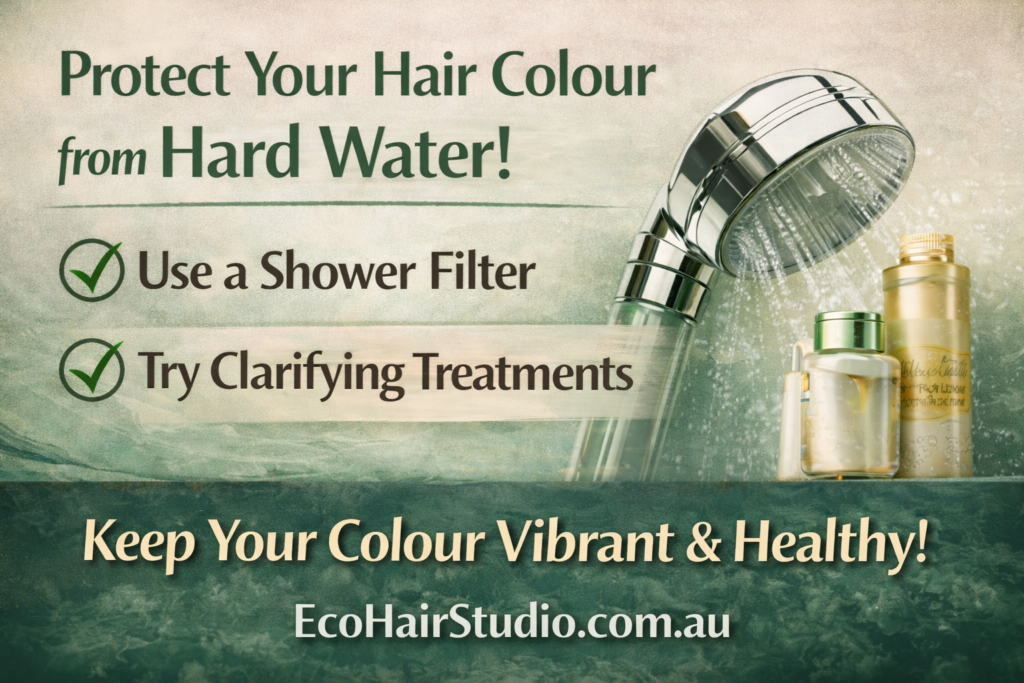
➡️ Use a Chelating or Clarifying Shampoo (Monthly)
A chelating shampoo is specifically formulated to bond with and remove mineral deposits from the hair shaft. Unlike regular clarifying shampoos, which lift general product buildup, chelating formulas target the calcium and magnesium that hard water leaves behind. Use one once a month to reset your hair — but not more frequently, as they can be drying.
➡️ Rinse With Filtered or Cooler Water
Hot water opens the cuticle further and accelerates mineral absorption. Rinsing your hair with cooler water — and ideally filtered water if you can manage it — reduces the amount of minerals deposited each wash. A showerhead filter designed to remove calcium and chlorine is a relatively affordable investment that many Perth clients swear by.
➡️ Use an Apple Cider Vinegar Rinse
An ACV rinse is mildly acidic, which helps counteract the alkalinity of hard water and smooth the cuticle.
Dilute one tablespoon of apple cider vinegar in a cup of water and use as a final rinse after shampooing. Leave for 30 seconds, then rinse out. It’s not a permanent fix, but it’s a cheap and effective maintenance tool.
➡️ Extend Time Between Washes
Every wash exposes your colour to more minerals. If you can stretch your washes from every day to every two or three days — using dry shampoo in between — you reduce cumulative mineral exposure significantly.
➡️ Use a Bond-Building Treatment Between Appointments
Products that contain ingredients like hydrolysed keratin, amino acids, or bond builders (similar to Olaplex-style chemistry) help reinforce the internal structure of your hair shaft. This makes it more resistant to the damage caused by repeated cuticle lifting from hard water exposure.
How Eco Hair Studio’s Approach Minimises Hard Water Damage
This is where your choice of salon and colour formula actually makes a meaningful difference — not just to how your colour looks on the day, but to how long it lasts.
➡️ Ammonia-Free, Botanical Colour Seals Better
Traditional ammonia-based colour aggressively forces the cuticle open to deposit pigment. When you’re already dealing with hard water, raising your cuticle at home, starting from a compromised base, makes the problem worse. Our ammonia-free colour formulas — using Aveda and O&M — open the cuticle gently and are designed to seal in more effectively after processing, giving you better colour retention from the start.
➡️ pH-Balanced Formulas Work With Your Hair’s Natural State
Both Aveda and O&M colour systems are formulated with scalp and hair pH in mind. They deposit colour without drastically altering the hair’s acid-alkaline balance, which means the cuticle is less disrupted and colour sits more stably inside the cortex — making it more resistant to the oxidising effects of hard water minerals.
➡️ We Recommend The Right Aftercare For Perth Conditions
Part of every colour appointment at Eco Hair is a genuine conversation about your hair at home — not a generic product pitch. We’ll recommend specific products suited to hard water conditions, advise on wash frequency, and flag if your hair is showing signs of mineral buildup that we can address during your next visit.
👉 At Your Next Appointment, Ask Us About:
• Whether your hair is showing signs of mineral buildup
• Which O&M or Aveda aftercare products work best for hard water
• Whether a chelating treatment before your colour service would help
• How to adjust your home routine to extend your colour’s life in Perth
The Bottom Line
➜ If you’re in Perth and you colour your hair, hard water is a background reality you need to work with — not against. The good news is that once you understand what’s happening, the solutions are manageable: a chelating shampoo, a cooler final rinse, less frequent washing, and a colour formula that’s designed to hold.
➜ At Eco Hair Studio, we’ve built our entire approach around hair health — and that means thinking beyond what happens in the chair. If you’re frustrated with colour that fades too fast or hair that never quite feels right, no matter what you do, we’d love to take a closer look and build a plan that actually works for your hair and your water.
Frequently Asked Questions
1. Can Hard Water Permanently Damage My Hair?
Mineral buildup is reversible with the right treatment. However, if it goes unaddressed for a long time and is combined with aggressive chemical processing, it can contribute to cumulative damage. The good news is that most of the visible effects — dullness, dryness, colour fading — improve relatively quickly once you address the mineral issue.
2. Will a Water Softener Help My Hair?
Yes, whole-home water softeners replace calcium and magnesium with sodium ions, which are much gentler on hair. However, they are expensive to install and maintain. A shower-specific filter is a more practical starting point for most people.
3. Does Hard Water Affect All Hair Types The Same Way?
Finer and more porous hair tends to be more affected, as is hair that is already chemically processed (coloured, bleached, or treated). Thicker, coarser hair has a naturally tighter cuticle and may be slightly more resilient, but is not immune.
4. How Often Should I Use a Chelating Shampoo?
Once a month is a good starting point for most people in Perth. If your hair feels persistently coated or your colour is fading very quickly, you might use it every three weeks. Avoid using it more frequently than every two weeks, as it can strip hair of its own natural oils along with the minerals.