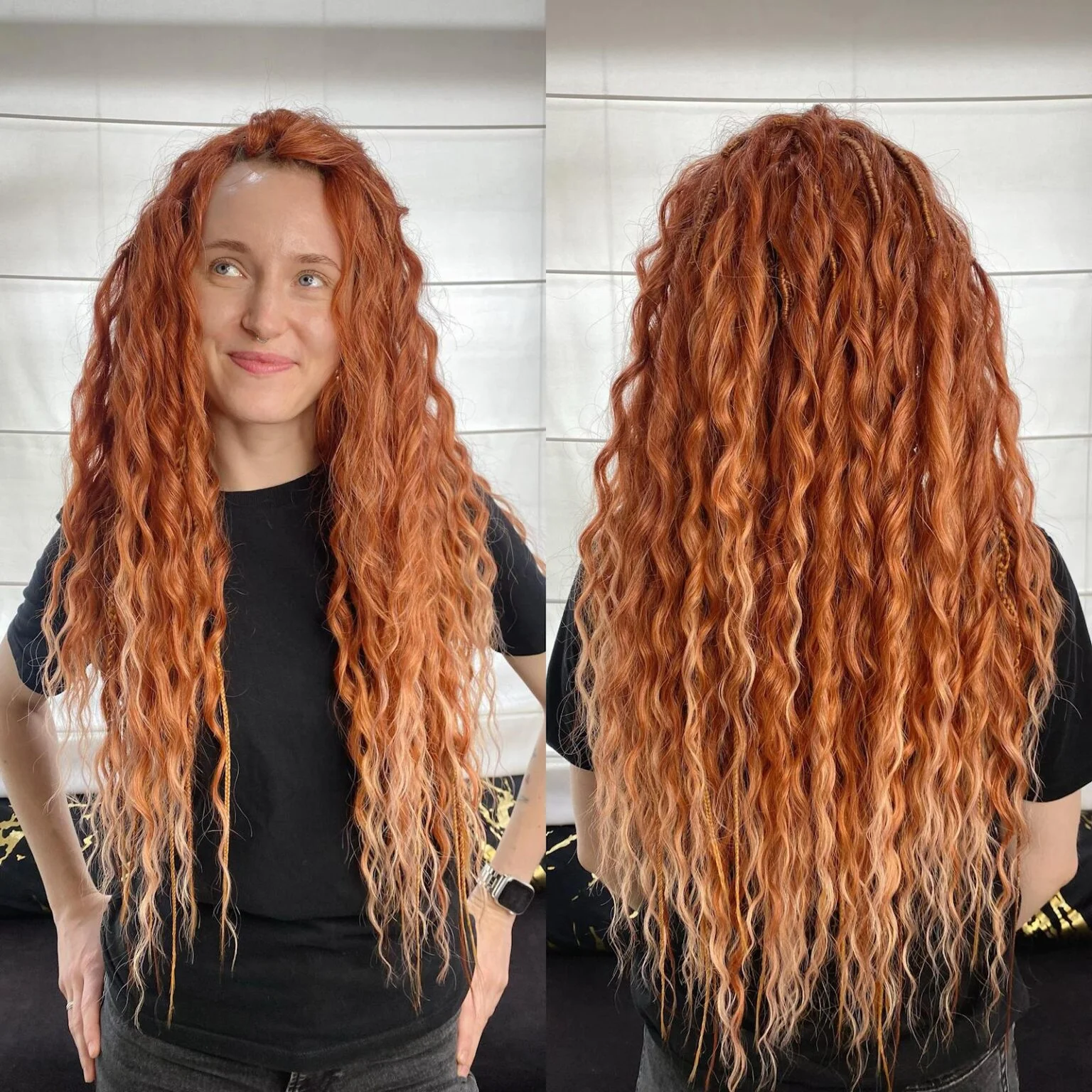
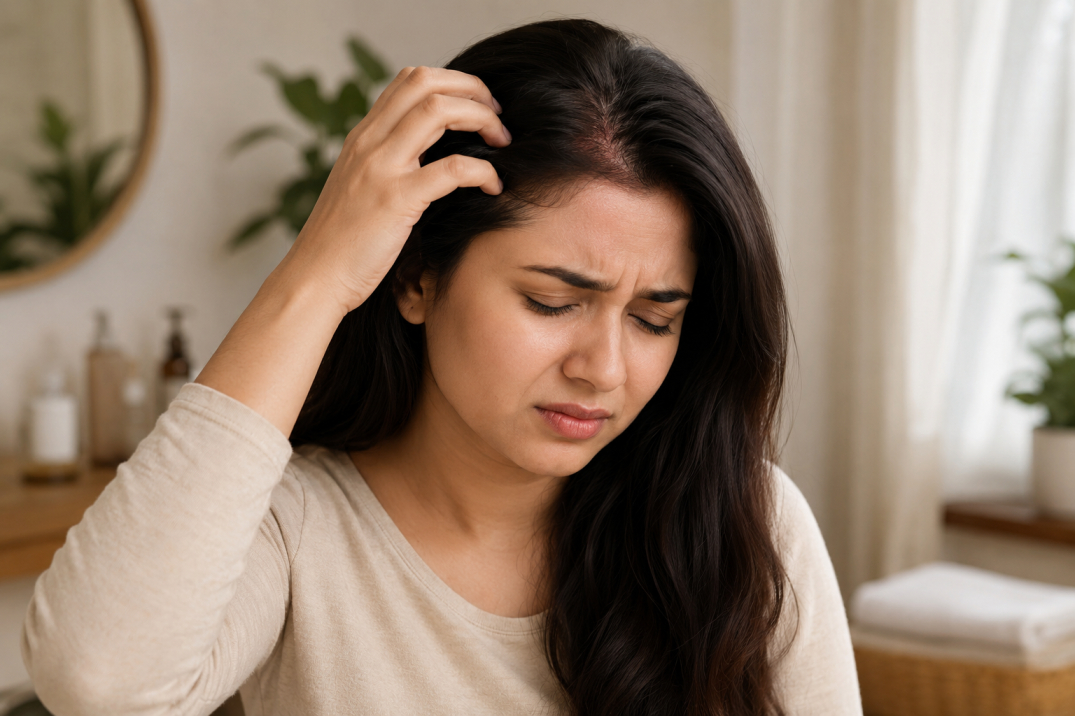
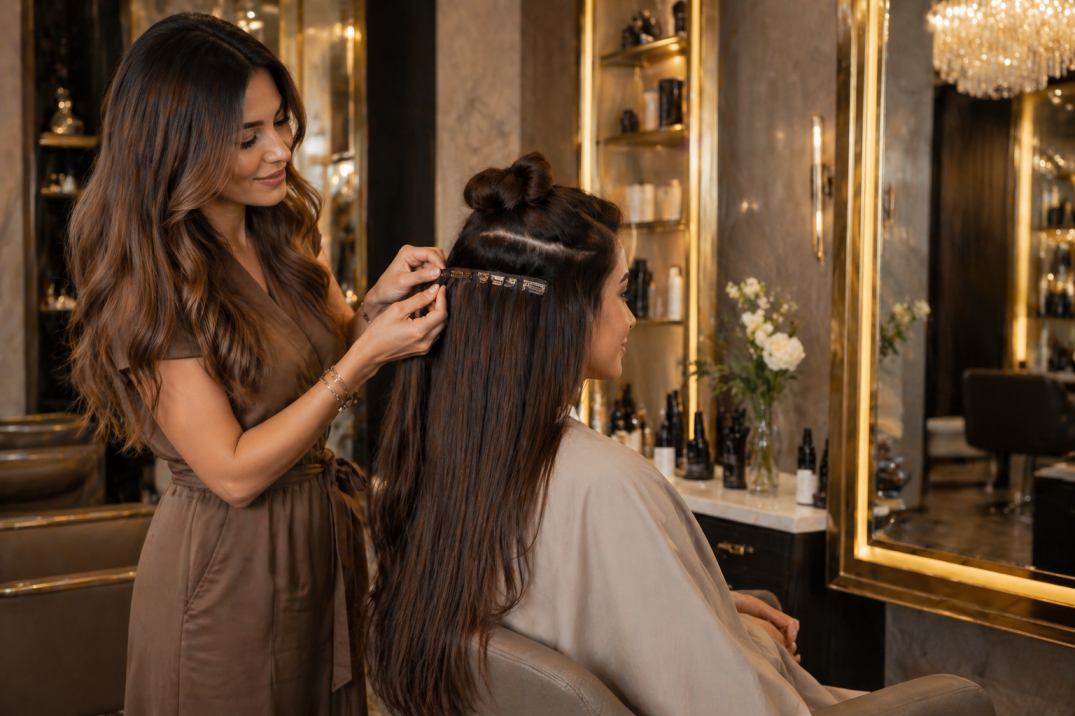
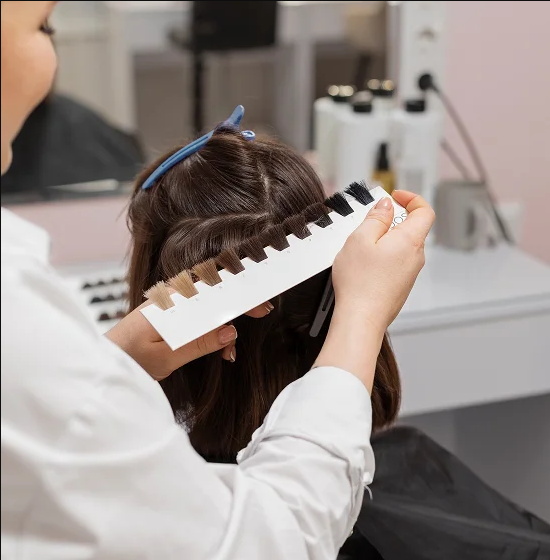
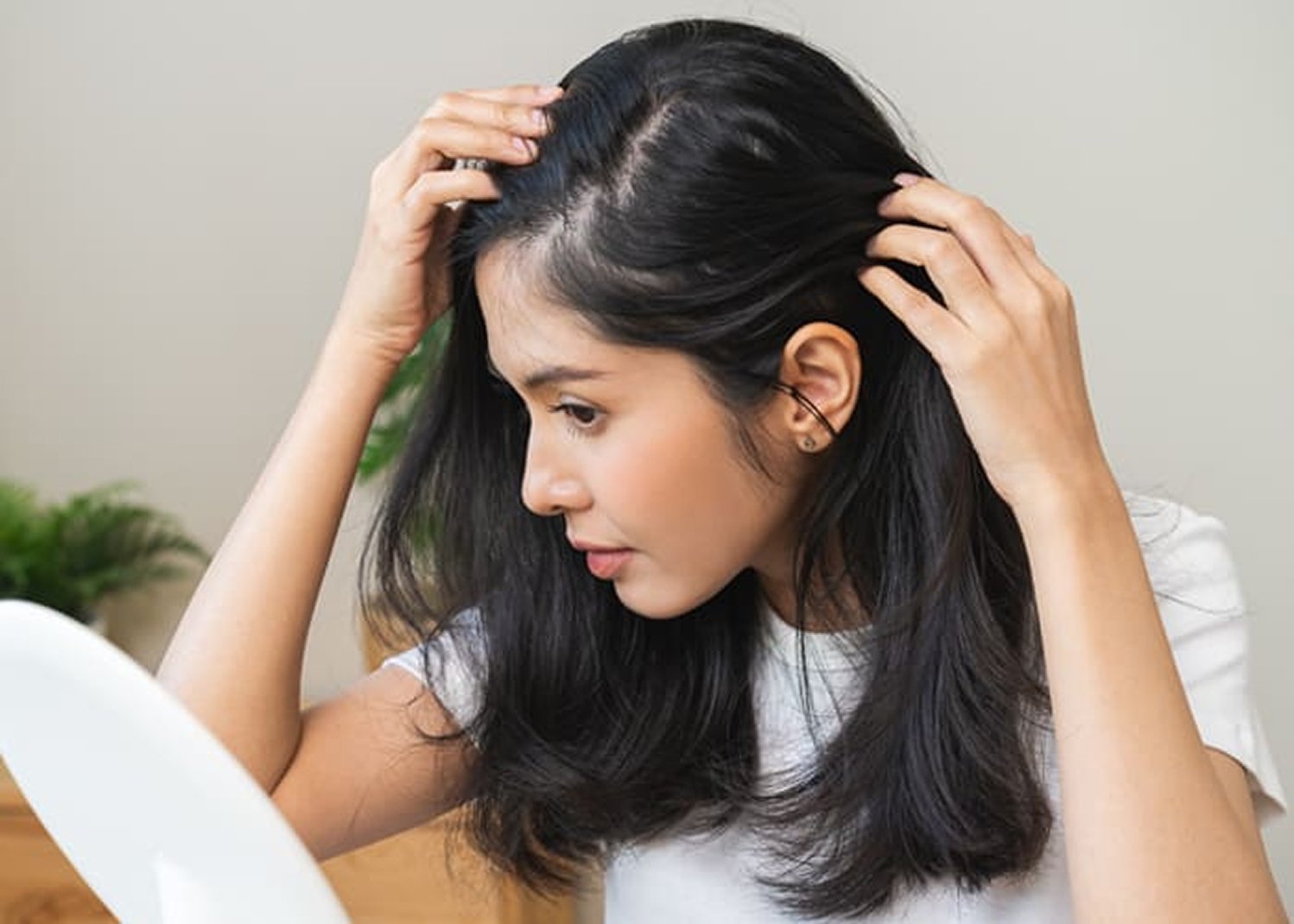
➜ Fine hair. Thinning hair. Postpartum shedding. Menopause-related density loss. These are the clients who come to us most anxious — and most transformed.
➜ There’s a widespread myth in the K-Tip Hair Extensions industry that fine or thinning hair can’t support extensions — that the hair isn’t strong enough, or that extensions will make the thinning worse. Like most myths, it contains a grain of truth and a lot of inaccuracy.
➜ The reality is that K-Tip Hair (keratin bond) extensions, applied correctly by a specialist who understands fine and thinning K-Tip Hair Extensions, are one of the most appropriate extension methods for this client group. This guide explains how they work, who they’re right for, what you should expect, and what questions to ask before you book.
What Are K-Tip Hair Extensions?
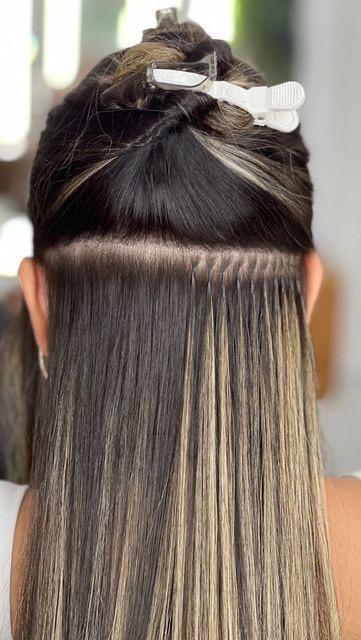
➜ K-Tip Hair extensions — also called keratin bond or fusion extensions — are individual hair strands pre-bonded with a keratin protein tip. The keratin bond is melted using a precision heat tool and fused to a small section of your natural hair, one strand at a time.
➜ This individual application is what distinguishes K-Tips from other extension methods like tape-ins, clip-ins, or weft extensions. Because each strand is applied individually, the stylist has complete control over placement, density, and weight distribution — which is critical when working with fine or thinning hair.
K-Tip Hair Extensions at a Glance
• Application: Bond-by-bond, individual placement using a heat tool
• Hair type: 100% single-donor Remy human hair — blends seamlessly
• Lifespan: 3–6 months with proper care
• Move-up appointments: Required every 2–3 months as natural hair grows
• Available in: 100+ shades — colour-matched to your natural hair
• Safe for: Fine hair, thinning hair, postpartum loss, menopause-related thinning
• At Eco Hair Studio: Currently available at $990 (limited time, was $1,390)
Why K-Tip Hair Extensions Are Particularly Suited To Fine and Thinning Hair
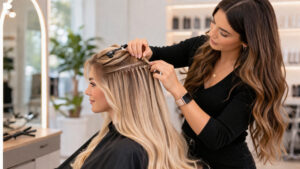
➡️ Precision Placement Avoids Weak Zones
A skilled K-Tip specialist — unlike a technician applying tape-ins or a weft — can look at your scalp, identify which areas have healthy enough density to support a bond, and completely skip areas that don’t.
For clients with patchy thinning, postpartum hairline recession, or menopause-related diffuse loss, this is enormous. It means extensions are added where you need them, and leave vulnerable areas alone.
➡️ Weight Is Distributed Strand by Strand
One of the biggest risks with extensions on fine hair is adding too much weight to too few natural strands. K-Tip Hair extensions are applied at a ratio your stylist calibrates to your individual hair density — typically one extension strand per two to four natural hairs. This distributes the weight safely, reducing the risk of traction (pulling) on already-fine follicles.
➡️ The Keratin Bond Is Gentle and Matched To Hair Protein
Keratin is the same protein your hair is made of. A well-formulated keratin bond is chemically compatible with the hair shaft, creating a bond that is secure during normal activity but releases cleanly during removal without stripping the cortex. Compare this to glue-based methods or tape adhesives, which can be significantly harsher on fine hair during removal.
➡️ They’re Invisible At The Scalp
Fine-haired clients are often most worried about the bonds showing through their hair. Because K-Tip bonds are small, flat, and applied close to the root, they are virtually undetectable in fine hair when applied by an experienced stylist. The extension hair fans out from the bond naturally, creating seamless volume.
Am I a Good Candidate For K-Tip Hair Extensions?
This is the most important question — and it requires an honest assessment, not a sales pitch. Here’s how we think about candidacy at Eco Hair Studio:
➡️ You’re Likely a Good Candidate If:
✦ Your thinning is diffuse (spread across the scalp) rather than in a specific bald patch
✦ You have at least 4–6 cm of natural hair length to work with
✦ Your scalp is healthy — no active infections, psoriasis, or severe dermatitis
✦ Your hair thinning is due to postpartum shedding, menopause, general fine hair type, or stress-related telogen effluvium
✦ You’re prepared to commit to the maintenance schedule (move-up appointments every 2–3 months)
✦ You understand extensions add volume and length — but don’t treat or reverse underlying hair loss
➡️ You May Need to Wait or Explore Alternatives If:
✦ You have active, progressive alopecia areata (patchy bald spots) — extensions cannot cover these effectively and may worsen traction in surrounding areas
✦ Your hair is severely compromised from chemical damage — we need some structural integrity to work with
✦ You have less than 4 cm of natural length
✦ You’re experiencing an acute illness or undergoing chemotherapy — hair loss in these contexts is different and requires specialist advice
✦ A consultation is always the right starting point. We will never sell you a service that isn’t appropriate for your hair — because extensions applied incorrectly to unsuitable hair cause damage, and that’s the opposite of what we do.
The Application Process: What To Expect
Step 1: Consultation and Hair Assessment
Before any extension is applied, your stylist will assess your natural hair density, scalp health, hair condition, and growth patterns. We’ll discuss your goal — more volume, more length, or both — and determine how many extension strands are appropriate. We’ll also colour-match to your natural K-Tip Hair Extensions or to the colour you’d like to achieve.
Step 2: Preparation
Your hair is washed with a sulfate-free, bond-safe shampoo and dried completely. Extensions must be applied to clean, completely dry hair — any moisture interferes with bond adhesion.
Step 3: Application
Your stylist works section by section, taking small sections of your natural K-Tip Hair Extensions, applying the extension strand, and fusing the keratin bond using a precise temperature-controlled tool. The bond is rolled between fingers to create a smooth, flat, oval shape that sits flush to the scalp. A full head application typically takes 3–5 hours, depending on how many strands are applied.
Step 4: Styling and Blending
Once all bonds are applied, your extensions are cut and blended to integrate seamlessly with your natural hair length. This finishing step is as important as the application itself — extensions that aren’t properly blended always look like extensions.
Step 5: Aftercare Briefing
Before you leave, your stylist will walk you through everything you need to know: how to wash, what products to avoid, how to sleep, and when to book your move-up appointment. This is not optional — following the aftercare guidelines directly determines how long your extensions last and how healthy your natural K-Tip Hair Extensions remain underneath.
Caring For K-Tip Hair Extensions On Fine Hair
| Do | Don’t |
|---|---|
| Use sulfate-free, extension-safe shampoo | Use shampoo with sulfates or high alcohol content |
| Wash with a downward, gentle motion | Scrub or pile hair on top of head when washing |
| Brush from ends upward using a loop brush | Brush from roots — can pull bonds |
| Sleep with hair in a loose braid or plait | Sleep with hair loose and unprotected |
| Use a silk or satin pillowcase | Use cotton pillowcase — causes friction on bonds |
| Book move-up appointments every 2–3 months | Leave bonds longer than 3 months — they migrate and tangle |
| Avoid applying oils or conditioner near bonds | Apply heavy product to roots and bonds — weakens adhesion |
| Use heat protectant on extension hair | Apply direct high heat to keratin bonds |
Cost and What’s Included at Eco Hair Studio
➜ K-Tip Hair extensions are a premium service — and the cost reflects the skill, time, and quality of hair involved. At Eco Hair Studio, we currently offer a limited-time K-Tip installation at $990 (regular price $1,390). This represents a $400 saving on the installation cost.
➜ What’s included: 100% single-donor Remy human hair in 100+ shades, full application by a certified K-Tip specialist, cut and blend to integrate with your natural hair, and a full aftercare consultation. Afterpay and Zip Pay are available.
➜ Move-up appointments (required every 2–3 months as your natural hair grows) are a separate cost. We’ll quote you at your initial consultation based on how many strands were applied.
The Bottom Line
➜ K-Tip Hair extensions for fine or thinning hair are not a compromise — when done well, they’re one of the most transformative services in professional hairdressing. The key is specialist skill, honest candidacy assessment, and a commitment to ongoing maintenance.
➜ At Eco Hair Studio, we specialise in K-Tip applications for exactly the clients who’ve been told extensions aren’t for them. If postpartum shedding, menopause-related thinning, or simply lifelong fine hair has knocked your confidence, come in for a consultation. We’ll show you what’s possible — honestly.
Frequently Asked Questions
1. Will K-Tip Hair Extensions Damage My Fine Hair?
Applied correctly — at the right density, with appropriate weight distribution, and with regular maintenance — K-Tip Hair extensions do not damage fine hair. The risk of damage comes from incorrect application (too heavy, too close to the scalp), leaving bonds in too long, or poor aftercare. This is why choosing an experienced specialist matters more than the method itself.
2. How Long Will K-Tip Hair Extensions Last On Fine Hair?
With proper care, 3–6 months before removal or re-application. Fine hair grows at the same rate as any hair — roughly 1–1.5 cm per month — which means bonds migrate away from the scalp over time. Most clients schedule move-up appointments at the 8–10 week mark to maintain the look before the bonds become visible.
3. Can I Colour My Hair While Wearing K-Tip Hair Extensions?
Yes, with limitations. We can tone or gloss the hair, including K-Tip Hair Extensions, and in some cases apply colour to the natural hair. Bleaching extensions that weren’t pre-lightened is generally not recommended. Your stylist will advise what’s safe and achievable at your appointment.
4. What Happens When I Have Them Removed?
K-Tip Hair extensions are removed using a bond-remover solution that breaks down the keratin bond without harsh pulling. Your natural hair is fully accessible once removed. We always include a scalp and hair assessment at removal — so we can check your natural hair health before deciding on re-application.
5. I’m Going Through Menopause — Is It Too Late To Get Extensions?
Absolutely not. Menopause-related hair thinning is one of the most common reasons our clients come to us for K-Tip consultations. The diffuse, generalised nature of hormonal hair thinning is actually well-suited to K-Tip application. We’ll be realistic with you about what extensions can and can’t do — they create volume and confidence, but they’re not a treatment for the underlying hormonal cause — and we’ll build a plan that works for your hair right now.